AI Will Eliminate Gatekeeping
AI isn’t just automating jobs—it’s removing gatekeepers. This article explores how AI tutors, skills-based hiring, and online learning are democratizing opportunity.
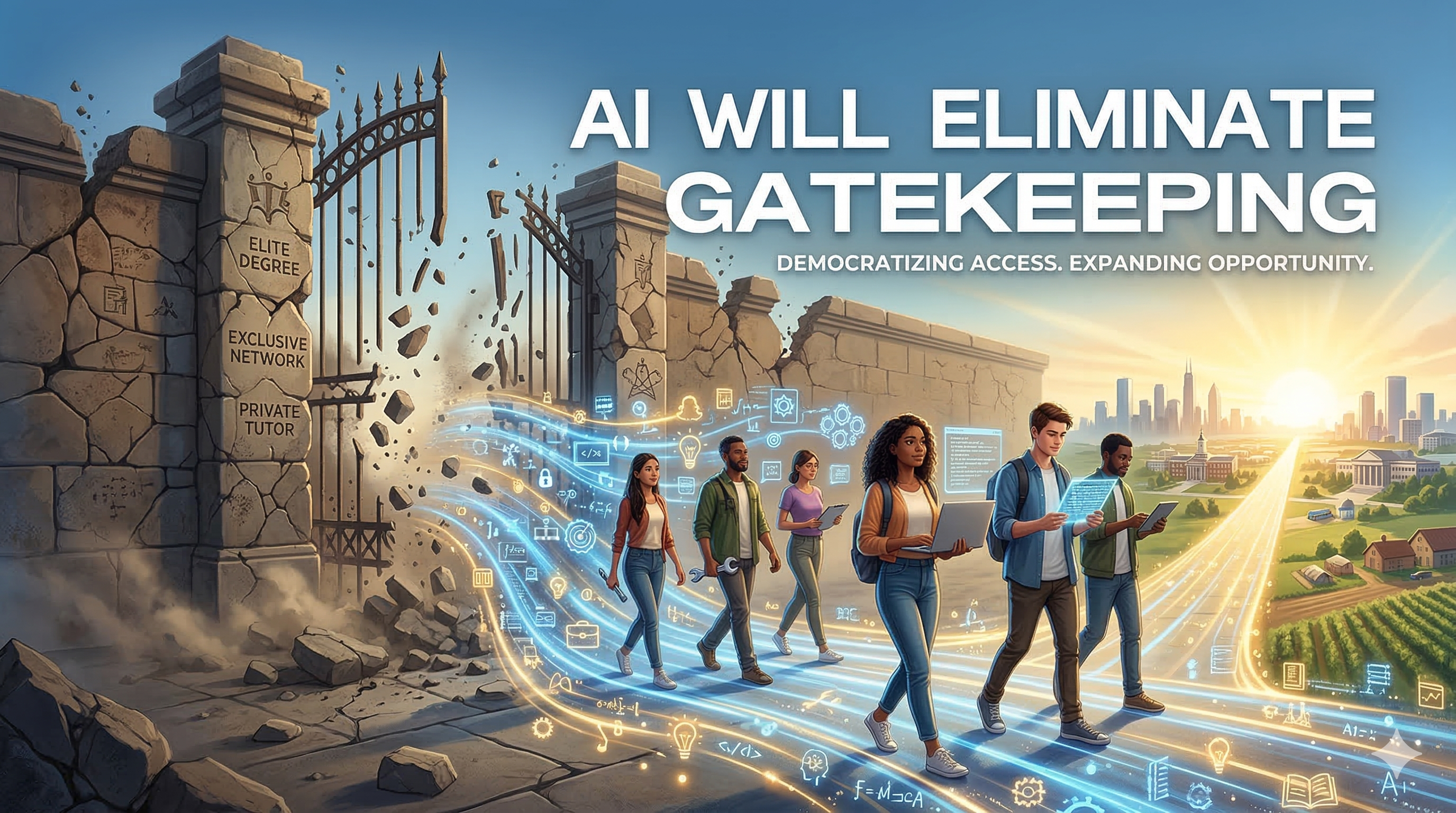
AI Will Eliminate Gatekeeping
I’ve been in the software engineering industry for over 10 years now. I remember saying a much smaller number, and then the time in between was a blur. Somewhere between my first job and fatherhood, the years stacked up.
And one thing has become clear: something big is changing. But not in the way the internet thinks.
The Dominant Narrative: Panic
Right now, the conversation is dominated by fear:
* Job Loss: AI will kill traditional roles.
* "Vibe Coding": The fear that AI will replace deep engineering expertise.
* Automation: Doctors and lawyers being phased out by algorithms.
* Economic Shift: The disappearance of the middle class.
Maybe some of that happens. But I think we’re missing the bigger story. AI isn’t just automation; AI is the largest removal of gatekeeping in modern history.
The First Gate I Ever Saw
If you grew up in the United States, you probably understand this intuitively. There are always gates.
Public school vs. private school was the first gate I remember noticing as a kid. I didn’t really know what private school was exactly. I just knew:
* It cost money.
* The kids seemed different.
* Their parents had resources.
Then middle school came around, and the whispers started: “The best football players go there.” “Their teachers are better.” “They have tutors.”
I was 13, 6'2", and 300 pounds. The football coach made my entry behind that gate pretty smooth. For the first time, I got to peek at what was on the other side.
What “Gates” Actually Look Like
When people hear the word gatekeeping, they think of arrogance or elitism. But most gates are much more subtle. They look like:
* A parent who knows how college admissions work.
* A private tutor available after school.
* A teacher who understands how to develop specific talent.
* A mentor who shows you exactly what to study.
* A network that opens the right doors.
The difference between two equally smart kids often isn’t intelligence—it’s information. One kid knows the path; the other is guessing.
The Hidden Curriculum
Educators call it the “hidden curriculum.” It’s everything you’re supposed to know that no one explicitly teaches you:
* Which classes actually matter.
* Which skills employers value today.
* How to interview and build a portfolio.
* How to find mentors and practice deliberately.
Historically, access to that curriculum was incredibly uneven. Some kids inherited it; others had to stumble into it.
Fast Forward to 2026
Now enter AI. Everyone is focused on the "scary" automation of coding assistants, design tools, and AI doctors. But look at this through a different lens: What if AI isn’t replacing expertise, but distributing it?
For the first time in history, a kid with a laptop can ask:
1. “Explain calculus to me like a tutor.”
2. “Teach me how to build an iOS app.”
3. “Simulate a technical interview for a Senior Dev role.”
They get answers instantly—not from a static forum, but from an interactive mentor.
The Great Equalizer
The real power of AI is not that it can write code. It’s that it can explain code. It can:
* Break down difficult concepts.
* Adapt explanations to the learner's level.
* Generate practice problems.
* Provide immediate feedback loops.
This collapses the distance between having a world-class teacher and having none. Young Torrey in public school now has access to the same level of guidance as Tim at an elite private academy.
Degrees vs. Skills: The Shift in Numbers
The labor market is already starting to reflect this shift. The monopoly universities once had on knowledge is weakening.
| Metric | Current Statistic (2025-2026) |
|---|---|
| Job postings requiring a Bachelor's | ~19.3% |
| Postings with no formal education requirement | ~51% |
| Global learners on Coursera | 190 Million+ |
| Google Career Certificate Graduates | 1 Million+ |
| Employer trust in micro-credentials | 96% |
Source: Indeed Hiring Lab (2026), Coursera Global Skills Report (2025).
The Merit Machine
For most of history, access determined opportunity. Now, the constraint is shifting to effort. AI doesn't magically make people skilled, but it dramatically lowers the cost of learning.
When the playing field gets flatter, the only things separating people are:
* Curiosity
* Discipline
* Persistence
* Practice
In other words: Work.
The Golden Age of Self-Made Experts
We are entering an era where you can go from curious beginner to employable expert without needing elite universities or wealthy parents. You just need:
1. Internet access.
2. A computer.
3. Relentless curiosity.
The Real Question
The debate about AI often asks: “What jobs will AI replace?” But the more interesting question is: What gates will AI remove? Because when the gates disappear, the most capable people win—not just the most connected.
Sources
- Indeed Hiring Lab. Where Do College Degrees Still Matter in a Skills-First Job Market? (2026).
- Coursera. Global Skills Report / Learning Trends 2025.
- Google. Grow with Google Career Certificates Impact Report (2025).
- Deming, D. (2017). The Growing Importance of Social Skills in the Labor Market. Harvard University.
Practice with real code
Turn the code and concepts you are learning into focused typing and review sessions.